Table of Contents
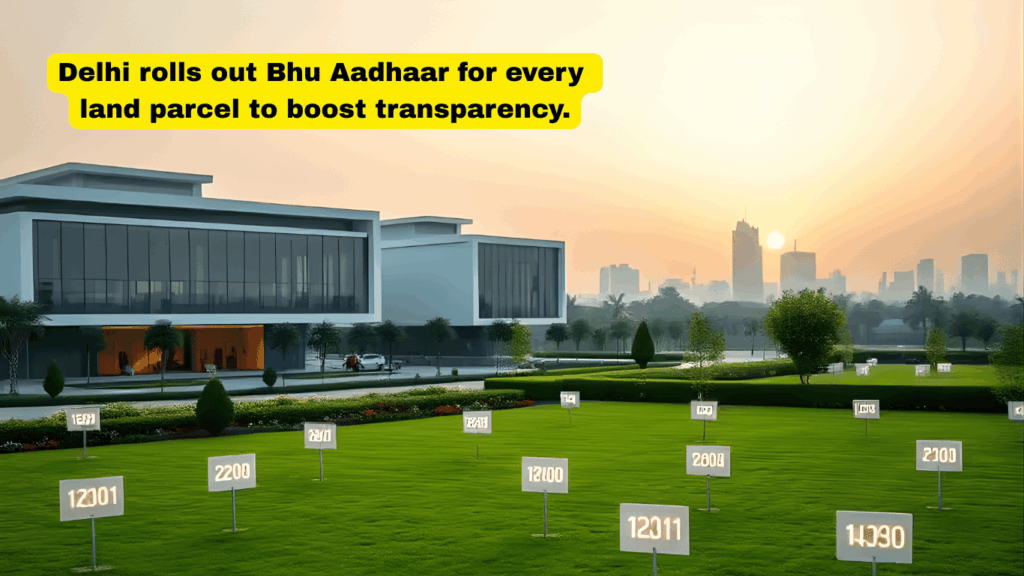
ToggleDelhi Launches Bhu Aadhaar to Digitally Identify Every Land Parcel with 14-Digit Unique ID
New Delhi: In a major step towards land record reforms and digital governance, the Delhi government has launched Bhu Aadhaar, a 14-digit Unique Land Parcel Identification Number (ULPIN) system aimed at modernising land records and ensuring transparency in property ownership across the national capital.
Announcing the initiative, Chief Minister Rekha Gupta said the move is designed to safeguard land ownership rights, reduce disputes, and bring greater accountability to property transactions. The system assigns a unique digital identity to every land parcel, similar in concept to the Aadhaar number issued to individuals, but specifically designed for immovable property.
What is Bhu Aadhaar?
Bhu Aadhaar is part of the broader land record digitisation framework being implemented under the Centre’s Digital India Land Records Modernization Programme (DILRMP). Under this initiative, each land parcel in Delhi will receive a 14-digit alphanumeric code that is geo-referenced and linked to ownership records, survey details, and registration data.
The Unique Land Parcel Identification Number (ULPIN) will serve as a permanent digital identifier, enabling seamless integration of land-related databases across departments. Officials stated that the system will help eliminate duplication, fraudulent claims, and manipulation of land records, which have historically contributed to disputes and litigation.
Objective Behind the Initiative
The primary objective of Bhu Aadhaar is to make land records tamper-proof, transparent, and easily accessible. Over the years, Delhi has witnessed numerous property-related conflicts arising from outdated or incomplete records. Manual documentation and fragmented data across multiple departments often resulted in confusion and legal complications.
By introducing a unified identification system, the government aims to:
- Digitally map every land parcel in Delhi
- Ensure real-time updates of ownership changes
- Reduce property fraud and illegal encroachments
- Simplify due diligence for buyers and financial institutions
- Strengthen urban planning and infrastructure development
Chief Minister Rekha Gupta emphasized that safeguarding citizens’ property rights remains a top priority. She noted that digitisation will not only improve governance but also boost investor confidence in Delhi’s real estate sector.
How the 14-Digit Number Works
The 14-digit Bhu Aadhaar number is generated based on geo-coordinates obtained through advanced GIS (Geographic Information System) mapping. Each number reflects the exact location and boundaries of a land parcel, making it uniquely identifiable.
Unlike traditional property identification methods that rely on plot numbers, khasra numbers, or local descriptions, the ULPIN is standardised and linked to digital maps. This ensures that even if administrative boundaries change or property subdivisions occur, the core identification remains intact.
Officials clarified that the number will be integrated with existing land registration systems, municipal databases, and revenue department records to ensure a seamless transition.
Benefits for Citizens
For property owners, the introduction of Bhu Aadhaar is expected to significantly reduce bureaucratic hurdles. Citizens will be able to verify land ownership details online, track mutation status, and access property records without visiting multiple offices.
The system is also expected to:
- Accelerate property transactions
- Improve access to bank loans through verified land records
- Reduce litigation arising from overlapping claims
- Enhance transparency in government land allocation
Legal experts believe that the initiative will streamline dispute resolution mechanisms, as accurate digital records can serve as strong evidence in courts.
Impact on Real Estate and Governance
Delhi’s real estate sector, which has long grappled with issues related to unclear titles and documentation gaps, is likely to benefit from the reform. Developers and investors often face delays due to verification complexities. A centralised digital identification system could significantly cut down processing time and improve trust.
Urban planners will also gain access to reliable spatial data, enabling better infrastructure development, zoning decisions, and land use management.
Moreover, government agencies can monitor encroachments and unauthorised constructions more effectively through geo-tagged land data.
Implementation Roadmap
Officials indicated that the rollout will take place in phases, beginning with digitisation and geo-referencing of existing land records. Field surveys, satellite imaging, and GIS mapping will be used to verify parcel boundaries.
The government is also expected to conduct awareness campaigns to educate citizens about the new system and guide them through verification processes. Property owners may be required to confirm or update certain details during the transition phase.
Authorities assured that the implementation will follow strict data security protocols to protect ownership information and prevent misuse.
Alignment with National Reforms
The Bhu Aadhaar initiative aligns with the Union government’s push for land record reforms across India. Under DILRMP, states are being encouraged to adopt ULPIN-based identification to create a unified national land database.
By implementing the system, Delhi joins other states that have begun integrating technology into land administration. The move reflects a broader shift toward digital governance and data-driven policymaking.
Challenges Ahead
While the initiative has been widely welcomed, experts caution that accurate mapping and verification will be critical to its success. Any discrepancies in geo-coordinates or legacy records could lead to confusion if not addressed carefully.
Coordination among revenue departments, municipal bodies, and registration authorities will be essential for seamless data integration. Additionally, regular updates will be necessary to ensure the system reflects changes such as subdivisions, inheritance transfers, and redevelopment projects.
A Step Toward Transparent Land Governance
With Bhu Aadhaar, the Delhi government aims to usher in a new era of transparency and efficiency in land administration. By assigning a 14-digit digital identity to every land parcel, the initiative seeks to reduce fraud, strengthen property rights, and modernise governance in the national capital.
As implementation progresses, the success of the programme will depend on technological accuracy, administrative coordination, and public cooperation. If executed effectively, Bhu Aadhaar could serve as a model for other urban centres across India striving to digitise and secure their land records.
Related Posts
- All Posts
- Blogs
- Commercial