
Commercial real estate has consistently been one of the most rewarding asset classes for investors seeking long-term wealth creation, regular rental income, and portfolio diversification. From office buildings and retail spaces to warehouses and business parks, commercial properties have the potential to deliver stable returns and capital appreciation over time. However, investing in commercial real estate has traditionally required substantial capital, limiting access for many individual investors.
The rise of fractional ownership has changed this landscape by enabling multiple investors to collectively own high-value commercial properties. This innovative investment model has opened the doors to premium real estate assets that were once reserved for institutional investors and high-net-worth individuals. Platforms like BrickPlatter are making this investment approach more accessible through professionally managed, income-generating commercial properties.
While fractional ownership is gaining popularity, purchasing a commercial property outright remains a preferred option for investors who want complete ownership and full control over their investment decisions. Both approaches offer distinct advantages, and selecting the right one depends on your investment goals, budget, risk appetite, and desired level of involvement.
This guide compares fractional ownership and direct commercial property ownership in detail, helping you understand which investment strategy is better suited to your financial objectives.
Table of Contents
ToggleUnderstanding Fractional Ownership
Fractional ownership is a real estate investment model where several investors jointly own a commercial property. Instead of purchasing the entire property, each investor buys a share and receives rental income and capital appreciation proportional to their ownership stake.
Unlike traditional property ownership, fractional investments are professionally managed. Asset managers oversee tenant acquisition, maintenance, rent collection, legal compliance, and day-to-day operations, allowing investors to earn passive income without managing the property themselves.
Through platforms like BrickPlatter, investors can gain access to premium commercial assets such as Grade-A office spaces, leased retail properties, and industrial facilities with significantly lower capital compared to buying an entire property.
What Does Buying a Commercial Property Involve?
Direct commercial property ownership means purchasing the entire property independently. The buyer becomes the sole legal owner and is responsible for every aspect of the investment, including financing, leasing, maintenance, legal compliance, taxes, and eventual resale.
Commercial properties can include:
- Office buildings
- Retail outlets
- Shopping complexes
- Warehouses
- Industrial units
- Business parks
- Mixed-use commercial developments
Although direct ownership provides greater flexibility and control, it also requires considerably higher investment and ongoing management responsibilities.
Investment Cost: Lower Entry vs High Capital Commitment
The biggest difference between fractional ownership and direct commercial property investment is the amount of capital required.
With fractional ownership, investors can participate in premium commercial real estate with a much lower investment amount. Rather than investing several crores in a single office building, investors purchase a fractional share, making commercial real estate accessible to a broader audience.
Direct ownership, however, requires a substantial financial commitment. In addition to the purchase price, investors must budget for stamp duty, registration charges, brokerage, legal expenses, furnishing costs, and ongoing maintenance. Many buyers also rely on commercial property loans, increasing their financial obligations through monthly repayments.
For investors looking to enter commercial real estate without deploying a large amount of capital, fractional ownership offers a practical solution.
Ownership and Control
Ownership structure significantly influences the level of control an investor has over a property.
In fractional ownership, investors own a percentage of the commercial asset. Major operational decisions are generally handled by professional asset managers or governed through investor agreements. This means investors benefit from professional expertise while avoiding the complexities of day-to-day management.
Direct ownership provides complete authority over the property. Owners decide whom to lease to, when to renovate, how to price the rent, and when to sell the asset. While this flexibility can maximize returns, it also requires considerable time, knowledge, and involvement.
Investors seeking a passive investment experience often prefer fractional ownership, while those who value autonomy may lean toward direct ownership.
Rental Income Potential
Commercial properties are widely appreciated for generating consistent rental income.
In a fractional ownership model, rental income collected from tenants is distributed among investors based on their ownership share after deducting applicable operating and management expenses. Because experienced professionals manage the property, investors receive income without handling tenant issues or maintenance.
In contrast, direct property owners receive all rental income generated by the property. However, they are also responsible for property taxes, maintenance, insurance, vacancy losses, repairs, and tenant management. Any disruption in occupancy directly affects the owner’s cash flow.
Diversification Opportunities
Diversification is one of the most significant advantages of fractional ownership.
Instead of investing all available capital into one commercial property, investors can spread their investment across multiple assets located in different cities or sectors. For example, an investor may own shares in an office complex, a logistics warehouse, and a retail property simultaneously.
This diversified approach helps reduce risk because the performance of one property does not entirely determine the overall investment outcome.
Direct commercial property ownership typically concentrates a substantial amount of capital into a single asset. If the property experiences prolonged vacancies or declining market demand, the investor bears the full financial impact.
Liquidity and Exit Options
Commercial real estate is generally considered a long-term investment, but liquidity remains an important consideration.
Fractional ownership platforms are increasingly introducing secondary marketplaces that allow investors to sell their ownership shares before the property’s final exit. While liquidity depends on buyer demand and platform policies, these mechanisms can provide greater flexibility than traditional property sales.
Selling an entire commercial property, on the other hand, often requires considerable time. The process involves property valuation, buyer negotiations, legal documentation, financing approvals, and registration, making direct ownership comparatively less liquid.
Property Management Responsibilities
Managing commercial real estate requires expertise and continuous attention.
With fractional ownership through BrickPlatter, professional asset managers handle leasing, maintenance, rent collection, legal compliance, tenant communication, financial reporting, and property operations. This makes the investment particularly attractive for professionals, NRIs, and investors who prefer passive income.
Direct property owners either manage these responsibilities themselves or hire property management companies at an additional cost. Responsibilities include tenant acquisition, lease renewals, maintenance scheduling, dispute resolution, tax payments, insurance management, and regulatory compliance.
The convenience offered by professionally managed fractional ownership can be a significant advantage for investors with limited time.
Risk Factors
Every investment carries risks, and commercial real estate is no exception.
Fractional ownership reduces concentration risk by allowing investors to diversify across multiple properties while sharing costs and operational responsibilities with other investors.
However, investors should carefully evaluate the credibility of the investment platform, property quality, tenant profile, lease terms, and exit strategy before investing.
Direct commercial property ownership exposes investors to risks such as vacancy, maintenance costs, market fluctuations, financing obligations, and tenant-related issues. Since the investor owns the entire asset, all financial risks remain solely with them.
Proper due diligence is essential regardless of the investment model.
Return Potential
Returns from commercial real estate generally come from two primary sources: rental income and capital appreciation.
Fractional ownership provides investors with regular rental distributions while allowing them to benefit from appreciation in the property’s value over time. Since professional asset managers oversee operations, well-managed properties often maintain strong occupancy levels and stable income.
Direct ownership gives investors complete access to rental income and future appreciation. Owners can further increase returns through property improvements, redevelopment, strategic leasing, or rental revisions.
While direct ownership may offer greater upside potential, it also requires more capital, expertise, and active involvement.
Expenses and Maintenance
Commercial properties require ongoing maintenance to preserve value and attract quality tenants.
In fractional ownership, maintenance expenses are shared among all investors and managed by professional asset managers. Investors are not required to coordinate repairs or negotiate vendor contracts.
With direct ownership, all maintenance costs fall on the owner. These expenses may include structural repairs, HVAC maintenance, electrical systems, plumbing, security, landscaping, and common area upkeep.
Unexpected repairs can significantly impact annual investment returns.
Who Should Choose Fractional Ownership?
Fractional ownership is particularly suitable for investors who:
- Want to enter commercial real estate with lower capital.
- Prefer professionally managed investments.
- Seek passive rental income.
- Wish to diversify across multiple commercial assets.
- Have limited time to manage property operations.
- Are first-time commercial real estate investors.
- Want exposure to institutional-quality commercial properties.
Platforms like BrickPlatter simplify the investment process by providing access to carefully selected commercial properties backed by professional management and transparent reporting.
Who Should Buy a Commercial Property?
Buying an entire commercial property may be more appropriate for investors who:
- Have significant investment capital.
- Want complete ownership and decision-making authority.
- Are comfortable managing tenants and maintenance.
- Seek long-term wealth creation through direct ownership.
- Have experience in commercial real estate.
- Want flexibility to renovate, redevelop, or reposition the property.
For business owners planning to use the property themselves, direct ownership may also provide strategic advantages.
Why Investors Are Choosing BrickPlatter
As commercial real estate evolves, investors increasingly seek investment solutions that combine accessibility, transparency, and professional management. BrickPlatter addresses these needs by offering fractional ownership opportunities in carefully selected commercial properties with strong income potential.
Instead of navigating complex property transactions independently, investors benefit from expert due diligence, asset management, tenant oversight, and operational support. This allows them to participate in premium commercial real estate while minimizing the administrative burden typically associated with direct ownership.
BrickPlatter’s approach enables investors to build diversified real estate portfolios while maintaining a lower entry barrier compared to purchasing an entire commercial property.
Key Questions to Ask Before Investing
Before deciding between fractional ownership and direct commercial property investment, consider the following:
- How much capital can you comfortably invest?
- Are you looking for passive income or active property management?
- Do you want complete ownership or shared ownership?
- What level of risk are you willing to accept?
- How important is diversification to your investment strategy?
- What is your expected investment horizon?
- How much liquidity might you need in the future?
Answering these questions can help you identify the investment model that aligns with your financial objectives.
Which Option Is Better?
Neither fractional ownership nor direct commercial property ownership is universally better. The ideal choice depends on your personal financial circumstances and investment goals.
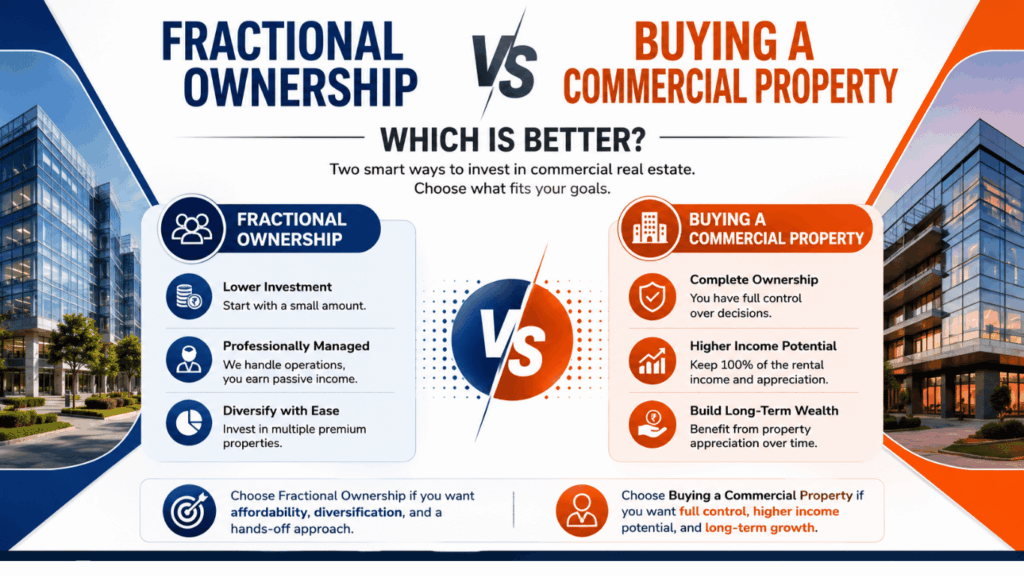
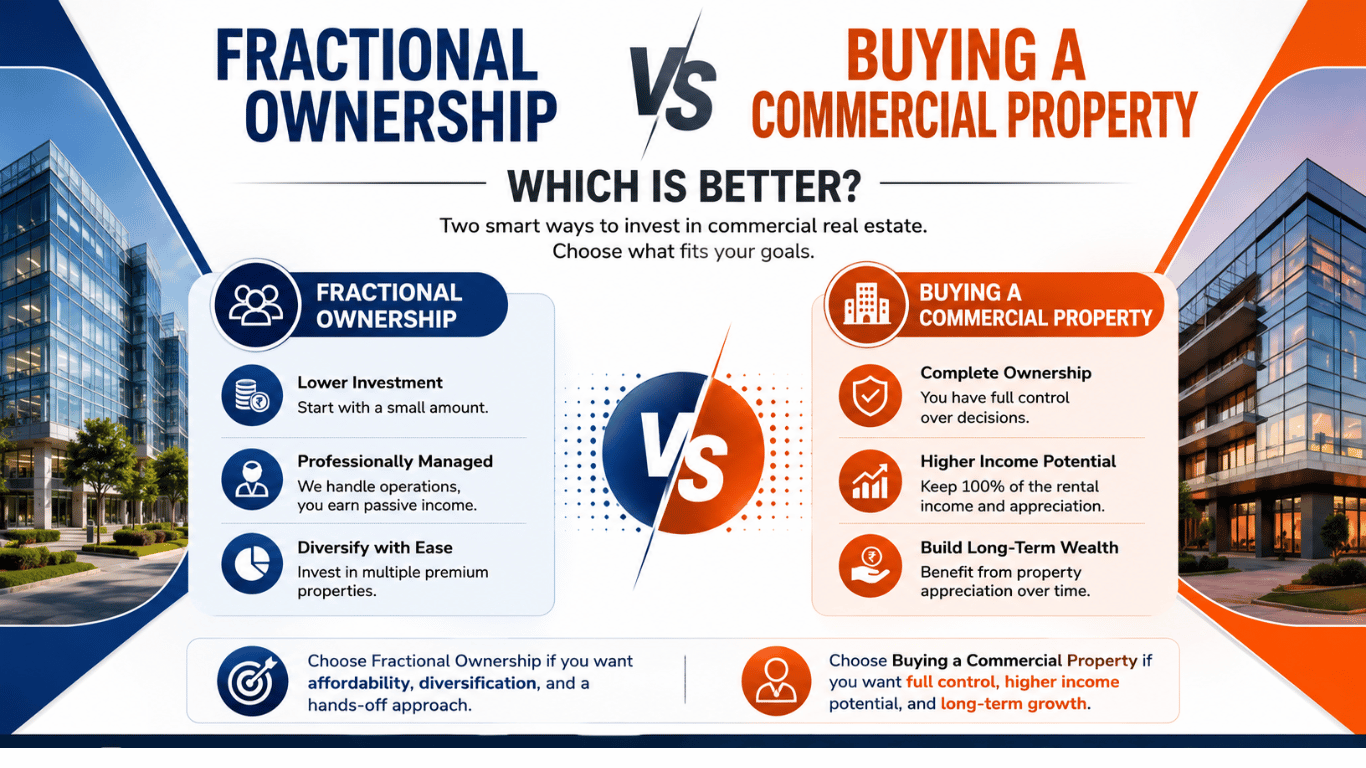
If your priority is affordability, diversification, passive income, and professional management, fractional ownership provides an efficient way to access premium commercial real estate. It allows investors to participate in institutional-quality assets without committing the substantial capital required for full ownership.
If you have significant financial resources, value complete control, and are comfortable managing every aspect of a commercial property, buying the asset outright offers greater flexibility and the potential for higher long-term returns.
Many experienced investors even combine both approaches, using fractional ownership to diversify across multiple commercial assets while maintaining direct ownership of selected strategic properties.
Conclusion
Commercial real estate remains one of the strongest long-term investment opportunities, offering the potential for stable rental income and capital appreciation. The emergence of fractional ownership has made this asset class more accessible than ever before, allowing investors to participate in premium commercial properties without purchasing an entire asset.
For investors seeking affordability, professional management, and diversified exposure, BrickPlatter provides an efficient pathway into commercial real estate through carefully curated fractional ownership opportunities. Meanwhile, direct commercial property ownership continues to be an attractive option for those who prefer complete control and have the capital and expertise to manage their investments independently.
Ultimately, the best investment strategy depends on your financial goals, available capital, risk tolerance, and desired level of involvement. By carefully evaluating these factors and conducting thorough due diligence, you can choose the commercial real estate investment approach that supports your long-term wealth creation objectives.