
Table of Contents
ToggleVERTICAL PROPERTY CARD: Maharashtra’s Game-Changing Property Reform
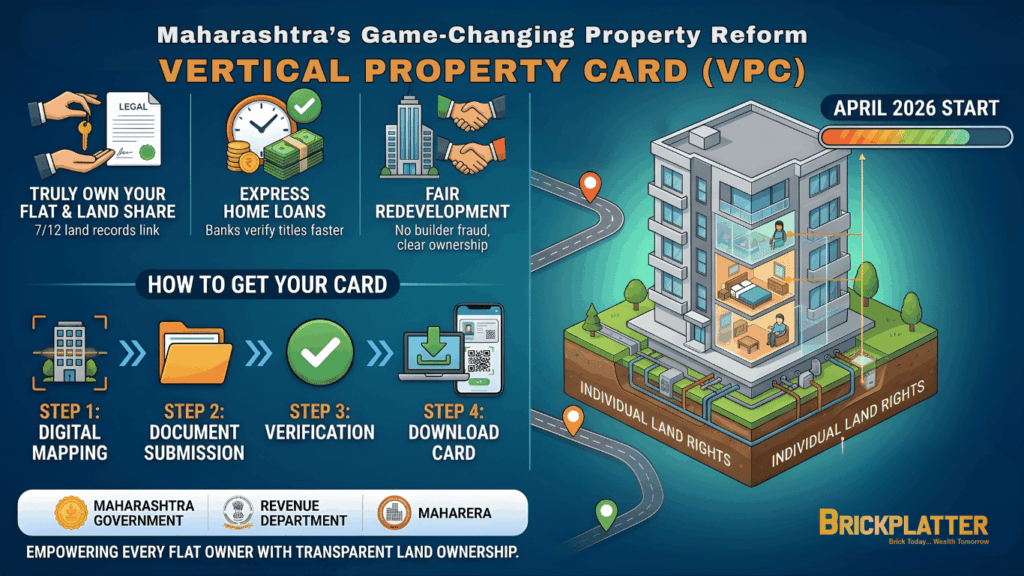
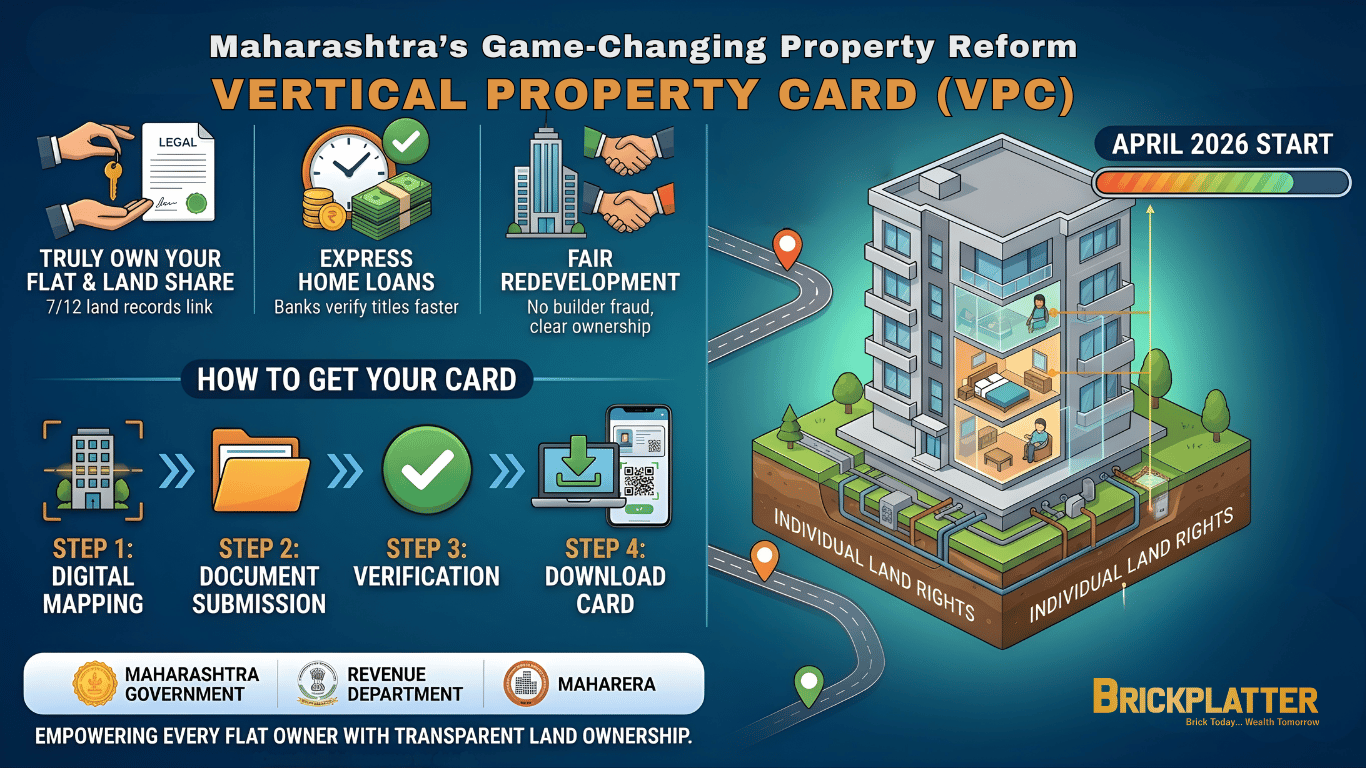
The Government of Maharashtra has introduced a landmark reform in the real estate sector with the launch of the Vertical Property Card (VPC). Announced by Chief Minister Devendra Fadnavis, this initiative is being hailed as one of the most significant property reforms in India’s history. Management of Brickplatter feels that for the first time, flat owners will not just own their apartment but will also have a legally recorded share of the land on which the building stands.
This revolutionary step aims to bring transparency, security, and efficiency to urban property ownership, especially in cities like Mumbai and Pune, where millions of people live in apartment complexes.
What is a Vertical Property Card?
A Vertical Property Card is an official legal government-issued document that records both your apartment (flat) and your proportional share of the land beneath the building. Traditionally, flat owners only had rights over their individual unit, while the land ownership remained unclear or collectively held without precise individual allocation. Traditionally, flat buyers only had rights over their individual unit, while the land ownership remained unclear or jointly held without specific allocation. With this new system, every flat owner will now have clearly defined rights over both the built-up area and the land, ensuring complete ownership.
With the introduction of the VPC, each flat owner will have:
- Ownership of their specific flat (built-up space)
- A clearly defined share in the land (horizontal ownership)
- Legal recognition similar to landowners in rural areas
In simple terms, this means your property ownership is no longer limited to “airspace” but includes a tangible portion of the land
Key Features of the Vertical Property Card
The Vertical Property Card comes with several important features that make property ownership more secure and transparent. It includes details such as the total area of the building, the flat owner’s exact share in the land, and a digital QR code for verification. The card also carries a digital signature, making it tamper-proof and easily verifiable by authorities, banks, and buyers. This ensures authenticity and reduces the chances of fraud in property transactions.
- Dual Ownership Structure: The Vertical Property Card introduces a dual ownership model:
- Vertical Ownership: Your apartment or flat
- Horizontal Ownership: Your share in the land
For example, if a building has a total carpet area of 10,000 sq. ft. and your flat is 800 sq. ft., your land share may be calculated proportionally (e.g., 99.25 sq. ft. of land).
- Inclusion in 7/12 Land Records: One of the most impactful changes is that flat owners’ names will now appear in the 7/12 extract, a crucial land record document in Maharashtra.
Earlier, this document was primarily associated with agricultural land and rural ownership. Now, urban flat owners will see entries like:
- Gat No. 456/2, Share 1/120
This gives apartment owners the same legal recognition as traditional landowners, significantly strengthening property rights. This means urban property owners in cities like Mumbai and Pune will now have their ownership officially recorded, just like landowners in villages. This step provides stronger legal backing and simplifies ownership verification.
- Digital Security with QR Code: Each Vertical Property Card will include:
- A QR code
- A digital signature
These features ensure:
- Protection against tampering or fraud
- Easy verification by banks, authorities, and buyers
- Seamless integration with digital land records
- Mandatory for New Properties: The government has made it clear that:
- All new flats will mandatorily receive a Vertical Property Card from 1st January 2026
- Existing flat owners (estimated at over 20 million) can obtain the card at a nominal fee of ₹500 by 2027
This phased approach ensures smooth implementation without disrupting the existing property ecosystem.
Benefits of the Vertical Property Card
The introduction of the Vertical Property Card offers multiple benefits. It provides clear land ownership rights, reduces legal ambiguity, and strengthens the owner’s position in property matters. It also makes it easier to sell, transfer, or mortgage a property. With proper documentation in place, flat owners can enjoy greater peace of mind and long-term security.
- Clear Land Ownership Rights: Previously, flat buyers often faced ambiguity regarding land ownership. With VPC:
- Your land share is clearly defined
- Legal disputes related to land ownership are reduced
- Ownership becomes more transparent and secure
- Faster Bank Loans and Approvals: Banks often hesitate to provide loans due to unclear land titles. With a Vertical Property Card:
- Ownership records become standardized
- Loan approvals become faster
- Mortgage processing is simplified
As per the announcement, processes like:
- Bank loans
- Redevelopment approvals
- Property transfers can now be completed within 48 hours.
- Simplified Redevelopment Process: Redevelopment has been a major pain point for housing societies in cities like Mumbai. Common issues included
- Builder disputes
- Lack of clarity in land ownership
- Unequal benefit distribution
With VPC:
- Each owner’s land share is predefined
- Transparency increases in redevelopment agreements
- Chances of fraud or manipulation reduce significantly
- Easy Inheritance and Property Transfer: Inheritance and succession often involve lengthy legal procedures due to unclear ownership structures. The Vertical Property Card simplifies this by:
- Clearly defining ownership
- Recording it in official land records
- Making transfer processes quicker and legally stronger
- Reduced Legal Disputes: Property-related court cases in India often drag on for decades due to unclear documentation. According to authorities, disputes can take 15–20 years to resolve. With VPC:
- Ownership records are precise and verifiable
- Legal ambiguity is minimized
- Dispute resolution becomes faster
Why Was This Reform Needed?
For decades, urban property ownership in India operated under a fragmented system. Flat owners had possession of their apartments but lacked direct ownership of the land.
Major challenges included:
- Builder fraud during redevelopment
- Unclear land titles affecting loans
- Lengthy legal disputes
- Lack of transparency in ownership records
Revenue Minister Mr. Radhakrishna Vikhe Patil emphasized that this reform eliminates complexities that have persisted for over 60 years.
How Does It Work?
The Vertical Property Card is based on proportional ownership. Here’s a simplified breakdown:
- The total land area of the building is calculated.
- The total carpet area of all flats is determined.
- Each flat owner is assigned a proportion based on their unit size.
- This share is recorded in:
- The Vertical Property Card
- The official 7/12 land record
This ensures a transparent and standardized ownership structure across all properties.
Impact on Real Estate Market
- Increased Buyer Confidence: With legally recognized land ownership:
- Buyers feel more secure
- Property transactions become more trustworthy
- Demand for registered properties may increase
- Boost to Housing Sector: The reform is expected to:
- Encourage more investments
- Reduce legal bottlenecks
- Improve ease of doing business in real estate
- Standardization Across Urban Areas: Cities like Mumbai, Pune, and others will benefit from:
- Uniform property documentation
- Digitized records
- Improved governance
Challenges and Considerations
While the Vertical Property Card is a progressive reform, its success will depend on:
- Efficient implementation
- Accurate data digitization
- Public awareness
- Coordination between government departments
Existing buildings may face initial challenges in calculating and verifying land shares, but the long-term benefits outweigh these hurdles.
Future of Property Ownership in India
The Vertical Property Card model could serve as a blueprint for other states across India. By bridging the gap between flat ownership and land ownership, Maharashtra has introduced a system that aligns with global property standards. This reform not only modernizes land records but also empowers millions of urban homeowners with stronger legal rights. Conclusion
The Vertical Property Card marks a transformative shift in how property ownership is defined in India. By granting flat owners a clear, legally recognized share of land, the government has addressed long-standing issues of ambiguity, disputes, and inefficiency. With digital integration, faster approvals, and enhanced transparency, this reform is set to redefine the real estate landscape in Maharashtra. As implementation progresses, it has the potential to become a national model for property governance.
For millions of homeowners, this is more than just a document-it is a step toward true ownership, security, and peace of mind.